Lead generation is a crucial activity for any business to acquire new clients and grow revenue. This guide will present the various steps for effectively acquiring qualified leads through phone prospecting.
While Sales prospecting can be incredibly powerful in a lead generation campaign, it requires a great deal of skill. Yes, Phone prospecting is a subtle discipline that must be handled with finesse. Done well, it can guarantee remarkable results, but if neglected, poorly executed, or done haphazardly, it is a recipe for assured failure.
Writing a Sales script, defusing objections, mastering intonations, actively listening to prospects to convince them, and setting an appointment are complex goals, even for the most well-equipped SDR.
Every day, whether in B2B or B2C, your potential clients are bombarded with calls and commercial messages. In this increasingly intense flood of solicitations, it becomes very challenging to stand out and capture your prospects’ attention.
Here are several essential points to optimize your lead acquisition and make Phone prospecting a formidable growth lever.
How to Generate Qualified Leads
Adapt Your Sales Pitch
Trying to please everyone ends up pleasing no one.
For reasons that elude us, this step is often neglected by marketing directors. Although it is the cornerstone of any marketing and sales campaign, failing to segment your audience guarantees failure!
Working on your audience allows you to adapt your messages to resonate with your prospects’ needs and ensure the generation of qualified leads. Your words will echo in their minds, they will see themselves in your arguments and think, “this is for me.”
Put simply, not segmenting your market means driving your campaign straight into a wall.
A Simple Method to Adapt Your Sales Pitch
One of the biggest obstacles to being heard and closing a deal or setting an appointment is the difficulty of adapting your sales pitch.
📅 Need qualified appointments ?
To move your prospects forward with you and achieve the desired lead generation, your messages must resonate in their minds. Follow an effective and original method.
Start at the broadest level, the industry sector. Gradually, shift your focus from the company your prospects belong to, to their role in the company, and finally to the individual themselves.
As you can see in this diagram, your pitch adapts to the specific character of each level for intense resonance. This is the opposite of what 90% of companies do: their pitches revolve around their products and their benefits.
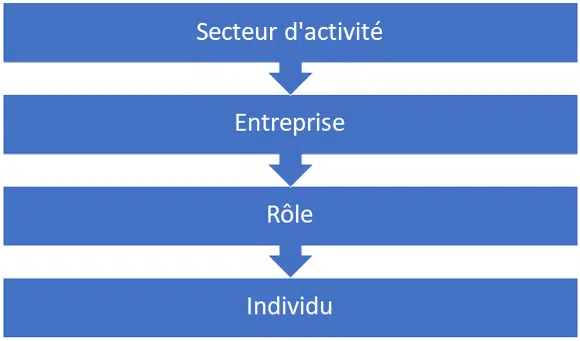
In this new approach, it’s not about you or your product but about your prospect, their needs, and what they aim to achieve.
At this level, the marketing department can add real value by adapting the sales pitches, primarily through information gathering.
Example:
- What are the major trends in the target industry?
- Have there been any recent mergers or acquisitions in this industry?
- Who are the leaders and challengers in this industry?
- Any recent regulatory measures? If so, which ones?
For the last two levels, mapping helps understand your personas, identify their roles, and comprehend what they aim to achieve. For example, when Leads Provider’s team addresses CIOs, they already know the roles and goals of these individuals within their companies, as they share common professional traits.
Call List in Database
This is an essential point that cannot be overlooked, as some production directors neglect it.
This inexperienced approach often relies on using a simple, imprecise, and random list of prospects for lead generation. Successful prospecting, which allows for acquiring quality leads, involves meticulous work on call lists.
📅 Need qualified appointments ?
You need to create a qualitative database by accurately determining who you are addressing. Ensure you target your audience appropriately, considering their profile in detail: industry, location, etc.
Listening to Call Recordings and Analyzing Initial Campaign Results
To find new clients once the target is precisely identified, your sales team will make numerous calls. There’s no way around it: this is the secret to quality lead acquisition. Motivating your sales team to make more calls will give you an interesting sample to listen to recordings. This is an absolutely necessary method for two reasons.
First, you will be able to check if your pitch hits the mark during the day. If not, you can adjust and refine it, making your discourse more relevant and your sales calls more effective.
The second reason is related to optimizing call lists to ensure you are targeting the right audience and sector.
Perfect Your Telemarketing Script to Acquire New Clients
For a sales script to be truly effective, consider its clarity and objective during its creation. Keeping in mind the goal of your pitch, which is to obtain a qualified lead at the end of the conversation, will make it a particularly impactful prospecting tool. Knowing exactly where you’re going helps you anticipate, adapt your pitch, and address objections without losing your way during the call. This approach strengthens your pitch and boosts your confidence. You’ll discover a perfectly beneficial and profitable conviction to win new clients.
Another point to consider when writing your telemarketing script is clarity: it should be constructed in a logical, straightforward plan. Consider several stages in your sales pitch, such as a mini-discovery, an announcement of the opportunity, a call to action, and a closing statement. A logical structure will help you have clear ideas and better progress towards your goal (sale, appointment, etc.).
Ask Smart Questions
Let your interlocutor speak. Ask precise and relevant questions that you have thought about in advance. The goal is to prepare the ground to optimize the rest of the conversation: it’s a way to refine your pitch and make it more precise. But be careful, don’t fall into an interrogation style. You risk coming across as intrusive and making the call rigid and unfriendly. Show sensitivity and turn the conversation into a pleasant exchange; for example, you can use what a prospect says to feed a subsequent question, all with fluidity and apparent spontaneity.
Anticipate Objections to Acquire Leads
Even the best telemarketers must face rejection and handle objections when working on generating qualified leads. It’s part of the job, so don’t expect to avoid it. With practice, a telemarketer learns to accept this aspect and sometimes even turn it into something positive. The prospect’s objections are an excellent way to understand their concerns and problems, and thus, ultimately, a formidable sales method to attract clients.
There are two main types of objections you can anticipate to better address them. There are generic ones like “I’m not interested” or “I don’t have time,” and more specific ones like “it’s too expensive” or “I don’t see how it can help me.” Here, the prospect is showing interest that you need to learn to capture to generate leads and attract new clients.
Cultivate Active Listening and Create a Conversation
📅 Need qualified appointments ?
Don’t hesitate to use and reformulate your interlocutor’s language elements; it’s an excellent technique to soften the exchange. In any case, avoid falling into a monologue. It’s the best way to cut the call short; no potential prospect will be receptive to this approach. To capture their attention and advance in lead acquisition, you need to evoke their emotions. Nothing works better than a pleasant and engaging conversation. Too many SDR monopolize the telemarketing exchange, leaving little room for their contact, often boring the interlocutor who doesn’t get the opportunity to provide potentially valuable information for a marketing strategy.
Finally, Adopt the Right Attitude to Generate Leads
Several key points optimize lead generation: careful preparation of the sales pitch, crafting the telemarketing script, asking pertinent questions, anticipating objections, and adopting active listening. Another equally critical aspect is your attitude, your demeanor. To successfully conduct teleprospecting and commercial lead generation, express positive attributes: a motivated attitude, optimism, self-confidence, and a pleasant voice. These qualities will help you successfully execute your prospecting campaign.